AI customer service agents vs standard live chat widgets
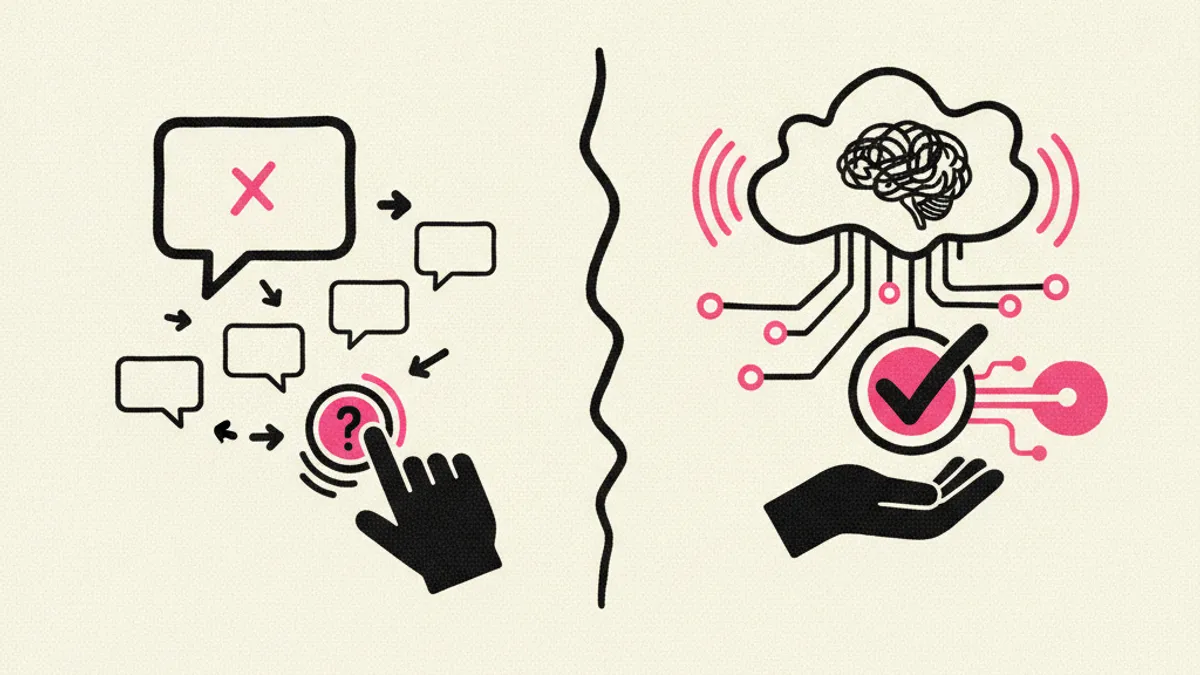
Founders often install a live chat widget on their website to capture leads and answer support questions. Within three weeks, that widget becomes a source of operational anxiety. It sits in the bottom right corner of the screen, pinging a dashboard that no one checks, or worse, routing messages to a mobile app that interrupts weekend dinners. The promise was better customer communication. The reality is a backlog of 47 unread messages, a frustrated user base, and a founder who feels chained to their phone. The conversation in operational circles has moved past simple notification tools. We are now evaluating the difference between software that merely routes a message and software that resolves the underlying problem.
defining the shift from basic auto-replies to contextual resolution systems
Standard live chat widgets operate on a simple premise. A user types a message, and the software notifies a human or triggers a hardcoded menu of options. "Press 1 for store hours, press 2 for returns." This is an auto-reply system built on rigid decision trees. It does not understand the context of the user's problem. If a customer asks if they can return a blue shirt they bought 14 days ago without a receipt, a standard widget will link them to a generic return policy page. The customer still has to read the page, interpret the policy, and figure out their next step. The software has done nothing to actually solve the issue.
An AI customer service agent operates differently. It functions as a contextual resolution system. When presented with the exact same question about the blue shirt, the agent checks the specific order number in your ecommerce backend, verifies the date of purchase, cross-references your internal policy regarding missing receipts, and replies with a definitive yes or no. It then generates the return shipping label and emails it to the customer. The shift here is from providing static information to executing dynamic tasks. You are no longer paying for a tool that holds a conversation. You are investing in a system that completes a workflow from start to finish. This distinction is critical when evaluating the best AI customer service tools for multi-location local businesses because the goal is to remove the workload from your store managers entirely, not just give them a new inbox to monitor.
comparing interaction drop-off statistics between humans and machines
In our experience reviewing chat logs for mid-sized operators, interaction drop-off is the silent killer of conversions and customer satisfaction. When a customer initiates a chat on a Tuesday at 9pm, a standard widget might say "We typically reply in 2 hours." The customer closes the tab. The interaction is dead. Even during normal business hours, if a human agent takes four minutes to look up a tracking number across three different browser tabs, the customer has often moved on to another task. We have seen drop-off rates exceed forty percent when response times stretch past the two-minute mark. Standard widgets try to mask this delay with typing indicators or holding messages, but customers recognize these stalling tactics immediately.
AI agents eliminate the latency variable. They retrieve tracking numbers, update billing addresses, and process partial refunds in milliseconds. The interaction remains continuous. The customer asks a question, receives an immediate and accurate answer, and completes their transaction without ever leaving the window. However, speed without accuracy causes a different type of drop-off. If an automated system provides a fast but irrelevant answer, the user abandons the chat out of deep frustration. This is why the underlying intelligence of the agent matters more than the raw speed of the software. A highly capable AI keeps the user engaged by actually solving the problem in real time, handling midnight customer DMs with the same precision as a midday inquiry. The metric that matters is not just time to first response, but time to final resolution.
processing variable user inputs like spelling errors and colloquial language
The defining limitation of a standard customer service widget is its reliance on exact keyword matching. If your rule-based bot is programmed to respond to the word "shipping", it will fail if a customer types "shippin" or asks "when will my box get here". Human language is inherently messy. Customers use regional slang, make typographical errors on small mobile keyboards, and structure their sentences poorly when they are in a rush. A human operator easily understands that "need to swap sizes" means the customer wants an exchange. A standard widget sees an unrecognized input and defaults to a frustrating loop, forcing the customer to guess the magic word the bot requires.
Modern AI agents process language semantically. They understand the intent behind the words, regardless of how those words are spelled or arranged. If a user types a fragmented, panicked message about a lost package containing three different spelling errors, the AI agent parses the core request without hesitation. It extracts the necessary tracking information, ignores the typos entirely, and responds calmly with the current location of the package. This capability is especially important when deploying automated systems on messaging platforms where users communicate in shorthand and fragmented sentences. For example, managing customer WhatsApp inquiries for local pharmacy owners requires a system that can understand medical terms spelled phonetically by stressed patients. The software must adapt to the customer, rather than forcing the customer to adapt to the software.
back-end integration capabilities for deep CRM updates and direct bookings
A conversation is only useful if it results in an action. Standard live chat widgets are typically siloed from your core operational software. They might integrate lightly with a central helpdesk to create a support ticket, but they rarely have the authority or capability to modify data within your primary systems. The human operator still has to manually copy the customer's new shipping address from the chat window and paste it into the CRM. They still have to open the scheduling software in a separate window to book an appointment. The widget is just a glass wall between the customer and your database.
An AI agent is designed to break that glass. It does not just read data; it writes data. When a customer requests an address change, the agent authenticates the user, accesses the CRM via a secure API, updates the address field permanently, and confirms the change with the customer in real time. If a client wants to schedule a consultation for next Thursday at 2pm, the agent checks the calendar availability, reserves the slot, and sends the calendar invite directly without human intervention. This level of back-end integration transforms the chat interface from a passive communication channel into an active operational command center. You are essentially giving the customer secure, guided access to your internal database to resolve their own issues. We build our customer service AI, Iris, specifically to execute these deep integrations, ensuring that every conversation translates into a tangible update in your systems.
how to choose based on your daily message queues and team size
The decision between a basic widget and an autonomous agent comes down to inquiry volume and operational overhead. If your business receives five inquiries a week, a simple live chat widget routed to your phone is perfectly sufficient. The manual effort required to answer those messages is negligible, and the cost of implementing a full AI solution might not be justified at that stage. You can handle those messages quickly without disrupting your day.
However, once your daily message queue hits a volume where it distracts your core team from their primary roles, the calculus changes dramatically. If your store manager spends two hours a day answering repetitive questions about parking validation, inventory availability, and return policies, you are paying a management salary for basic administrative tasks. In these scenarios, an AI agent becomes a required operational upgrade to protect your margins. You must evaluate the complexity of the requests. If the majority of your inquiries require looking up information in a database or executing a standardized process, an AI agent will handle them flawlessly and scale infinitely. If your inquiries are highly customized, sensitive, or require nuanced human judgment, you might still need human oversight, but the AI can handle the initial triage and data collection. The goal is to match the tool to the operational bottleneck. Do not buy software just to look modern. Buy software to buy back your team's time and increase your operational capacity.
---
When your customer inquiry volume outgrows your team's capacity to respond manually, you need a system that actually resolves tickets instead of just routing them. Iris is our customer service AI designed to integrate directly with your backend systems, process complex requests, and execute workflows without human intervention. You can read more about how she handles frontline operations on the Iris overview page, or you can book a call to discuss how we can map her capabilities to your specific operational bottlenecks.