Traditional local SEO vs generative engine optimization for brick-and-mortar sites
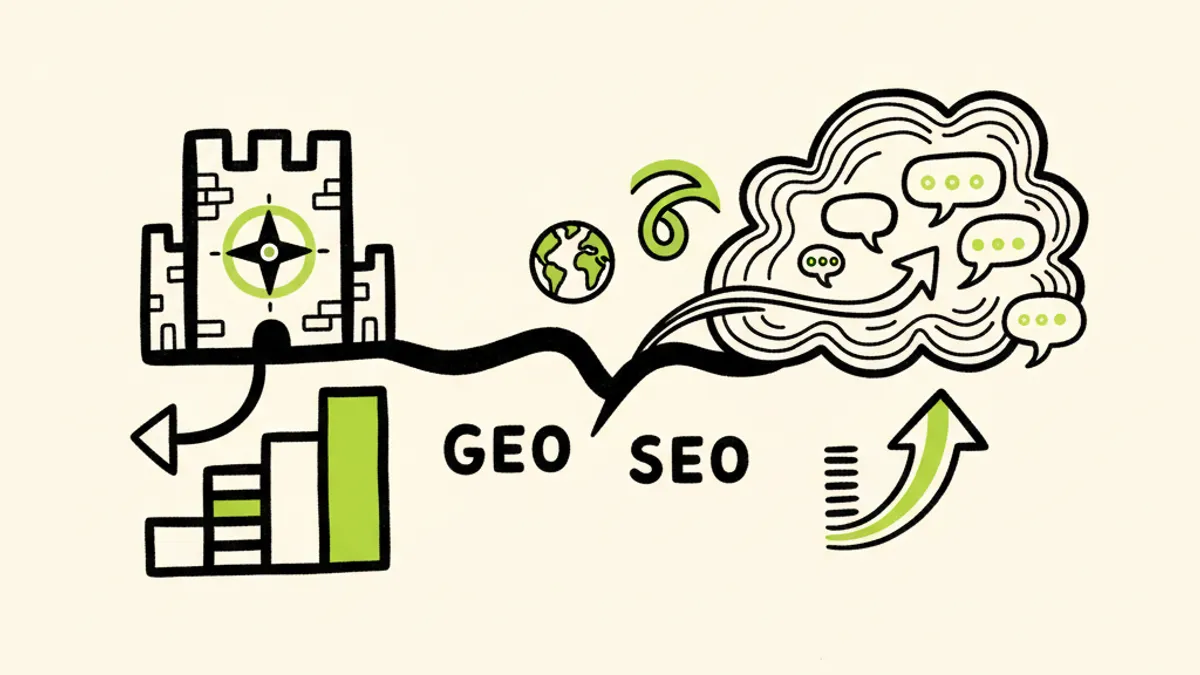
You check your dashboard on a Thursday morning and see steady clicks from Google Maps. Your physical store ranks well for "hardware store near me" or "boutique fitness studio downtown". But when a potential customer opens a chat interface and asks for the best place to buy brass cabinet hardware on a Sunday afternoon, a different set of rules applies. Navigating local search visibility vs ai engines is the new operational reality for brick-and-mortar founders. The tactics that put your business at the top of a traditional map pack do not automatically translate to a recommendation from a large language model. We see founders struggle with this gap daily. They have spent years building local authority, only to find themselves completely invisible when customers shift to conversational tools.
the dividing line between keyword map positions and conversational intent matching
Traditional local search engine optimization relies heavily on proximity, category tags, and exact keyword matching. If your dental practice is located exactly two miles from the searcher and your website title includes "Chicago Family Dentist", a traditional search algorithm connects the dots easily. The system plots coordinates on a grid and matches text strings to deliver a list of nearby options. Generative engine optimization operates on a completely different foundation. Large language models do not think in static coordinates or exact match phrases. They process the semantic meaning behind a query to construct a conversational response.
When a user asks an AI assistant to plan an afternoon itinerary that includes a quiet coffee shop with reliable wifi and plenty of outlets, the engine does not just look for the category "coffee shop". It searches its training data and live retrieval systems for specific contextual clues that satisfy the entire prompt. The dividing line between geo vs seo lies in this shift from rigid categorization to fluid intent matching. Traditional optimization asks if you are in the right category and the right zip code. Generative optimization asks if you are the best contextual answer to a highly specific, multi-layered question. If your website only lists your address and a generic paragraph about serving great coffee, an AI engine lacks the detailed context required to recommend you. This is often why what to do when ChatGPT recommends your business competitors becomes a pressing question for founders who dominate local maps but lose out in generative chat interfaces.
how language systems extract context from localized review signals
For a decade, local business owners have chased five-star reviews to boost their aggregate rating and improve their map ranking. A traditional search algorithm looks at review volume, average rating, and recency to determine authority. A generative engine looks at the actual words your customers write. AI models treat customer reviews as a massive corpus of unstructured data to be mined for specific facts and operational details.
If a customer writes a detailed review in November mentioning that your auto repair shop successfully diagnosed a strange rattling noise in their 2019 hybrid engine, a traditional search engine might just log it as another positive signal. A generative engine extracts the concepts of hybrid engines, diagnostics, and rattling noises, associating them directly with your business entity. When a future user prompts an AI for a mechanic who is good with hybrid engine noises, the engine retrieves your business based on that specific review text. This means founders need to rethink how they encourage customer feedback. Asking a customer to simply leave a five-star review is no longer enough. You need them to mention exactly what they bought, the specific problem you solved, and the context of their visit. If you run a local nursery, a review stating you have a great selection of native drought-tolerant shrubs for clay soil is infinitely more valuable for generative engine optimization than a generic comment about friendly staff. The language system uses these granular details to build a comprehensive understanding of your physical location.
analyzing user question variations across search bars and voice applications
The way a person types into a traditional search bar is fundamentally different from how they speak to a voice assistant or type into a conversational interface. Search bar behavior is historically brief and highly transactional. A user types "emergency plumber 30301" or "pizza delivery open now". Traditional local SEO is perfectly tuned to capture these short, disjointed keyword strings through targeted landing pages and metadata.
Conversational queries are long, complex, and highly specific. A user talking to their phone while driving might ask for a local hardware store that carries metric socket sets and is open past 7 PM on a weekday. Understanding how local businesses surface in claude or other language models requires analyzing these natural language variations. Users are no longer stripping away the context of their search; they are leaning heavily into it. They expect the AI to do the heavy lifting of filtering out irrelevant options. This means your digital footprint must contain the answers to these long-tail, hyper-specific questions. If your website does not explicitly state your evening hours, the specific brands you carry, or the exact services you provide in plain language, the AI cannot confidently recommend you. It will bypass your business in favor of a competitor whose website provides the necessary depth of information to satisfy the complex voice prompt. You must anticipate the conversational questions your best customers ask and ensure those answers are clearly documented across your public-facing digital assets.
balancing metadata configurations with natural reading structures
The transition toward generative engines does not mean you can abandon traditional technical optimization. Google Maps and Apple Maps still drive massive amounts of foot traffic to brick-and-mortar stores. The challenge is balancing the rigid metadata required by traditional crawlers with the natural reading structures preferred by large language models. You still need accurate schema markup, consistent name, address, and phone number data, and fast page load speeds to maintain your baseline search presence.
However, you must weave this structured data into paragraphs that an AI can easily read and summarize. Traditional SEO often led to websites with disjointed lists of keywords at the footer or awkwardly phrased location pages designed purely for crawler consumption. Generative engines penalize this type of content. They prefer well-written, authoritative text that explains exactly what your business does, who it serves, and why it matters. You must structure your website so that a traditional crawler can easily parse your business hours through schema, while an AI model can read a natural paragraph explaining that your kitchen closes at 9 PM but the bar stays open until midnight. This dual-purpose formatting extends to technical files as well. Just as you maintain an XML sitemap for traditional search engines, learning how to format an llms.txt file for your business website provides a clean, text-only summary of your business specifically designed for AI crawlers to ingest. Optimizing website for ai search answers requires serving both the mechanical crawler and the semantic reader simultaneously.
adapting localized content playbooks to cover both platform behaviors
Founders must evolve their digital strategy to maintain their local visibility across both ecosystems. The old playbook of publishing generic, keyword-stuffed blog posts about your local area is entirely obsolete. To succeed in both traditional local SEO and generative engine optimization, your content must be deeply authoritative and highly specific. You need to document your physical business operations in meticulous detail so that no engine has to guess what you do.
Start by auditing the questions your frontline staff answers every day. If customers constantly call your clinic to ask if you have wheelchair access at the rear entrance or if you accept a specific tier of local insurance, that information needs to be clearly written on your website. Do not bury these details in a hidden interface or a messy PDF. Write dedicated, descriptive paragraphs about your facility, your inventory, and your service limitations. When you host a local event or partner with another neighborhood business, write a detailed summary of the collaboration. This creates semantic links between your business entity and other established local entities in the AI training data. Your goal is to become the most reliable, context-rich source of information about your specific niche in your specific town. By providing deep, factual content, you satisfy the traditional search engine requirement for localized relevance while giving generative engines the concrete details they need to confidently recommend your business in a conversational response. You can explore more strategies for building this dual-threat digital presence by reading through our blog.
---
If you are tired of losing local market share to competitors who understand how AI engines process localized data, it is time to upgrade your infrastructure. Dexi is our visibility AI designed to ensure your physical business ranks across both traditional maps and modern generative chat interfaces. You can learn more about how she manages your digital footprint on the Dexi page, or book a call with our team to get your first two weeks free.