Fractional chief of staff vs AI executive assistant for small teams
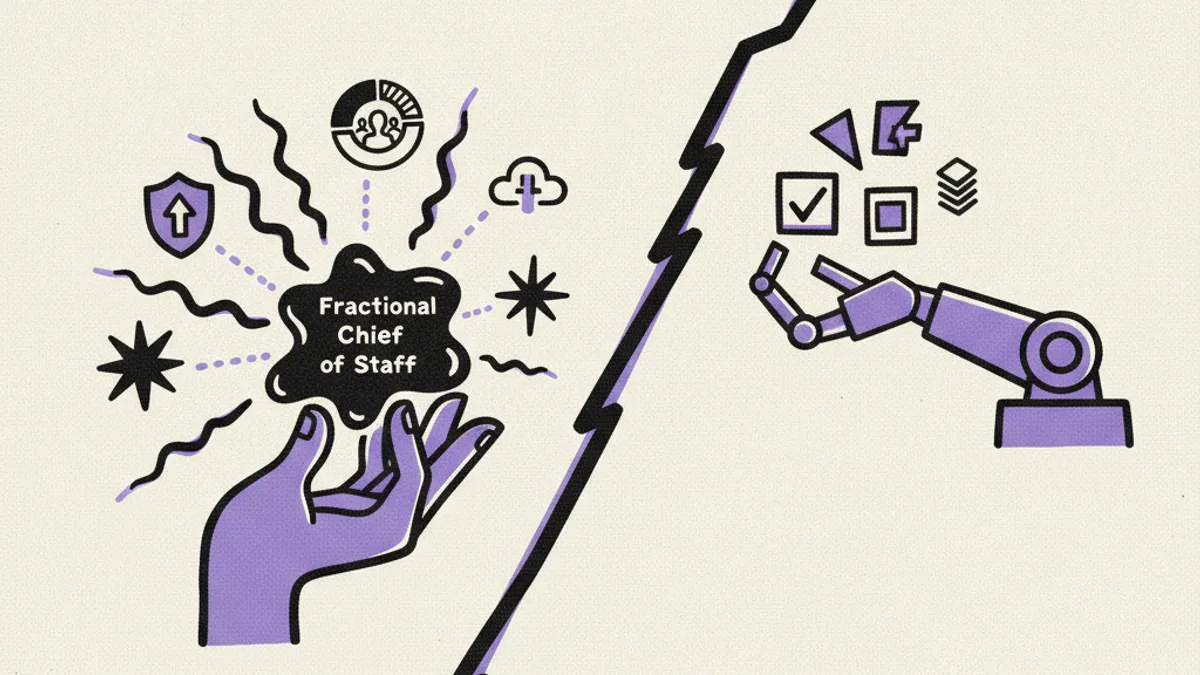
Founders of small companies eventually hit a wall where they spend more time hunting down spreadsheet discrepancies than actually running their business. You sit down on a Tuesday morning intending to close a major vendor contract, but instead you spend three hours cross-referencing Stripe payouts with inventory software just to figure out if you can afford the new hire you interviewed last week. The standard operational advice dictates that you need to delegate, usually by hiring an executive assistant or bringing on a fractional chief of staff. We have seen operators struggle with this exact decision for months. You know you need operational leverage to scale, but you also know that adding another human to the payroll introduces management overhead and training time. The choice between hiring a fractional chief of staff and deploying an AI executive assistant ultimately comes down to understanding what kind of leverage your business actually needs right now.
defining strategic management roles for growing small companies
When a business crosses the threshold of half a million in annual revenue, the founder's role shifts from doing the work to managing the systems that do the work. This transition is usually messy. You might have five different software platforms handling distinct parts of the business. You have a customer relationship manager, a payment processor, an inventory tracker, a payroll system, and a marketing platform. None of them talk to each other in a meaningful way, leaving you to manually connect the dots.
A fractional chief of staff is traditionally hired to step into this chaos and act as an operational bridge. They are a high-level strategist who works ten to twenty hours a week, organizing your priorities, auditing your software stack, and holding your leadership team accountable. They sit in on your Monday morning syncs, take detailed notes, and translate your broad vision into actionable tasks for your team members. Their primary value is human judgment and organizational alignment.
An AI executive assistant occupies a different but highly overlapping space. Instead of acting as a strategic sounding board, the AI acts as an omniscient observer of your existing data streams. It does not need to sit in on meetings to understand the state of the business because it has direct access to the raw data flowing through your company. If you want to dive deeper into the distinctions between human delegation and software delegation, our piece on AI employees vs traditional virtual assistants for small business operations covers the baseline differences. For the chief of staff role specifically, the distinction centers on strategy versus data synthesis. A human helps you figure out what to do next based on their experience. An AI gives you the exact numbers you need to make that decision yourself.
analyzing execution speed differences across human planners and data integrations
Speed is the most critical metric for a small business operator. When you ask a fractional chief of staff to compile a report on customer churn over the last quarter, you are initiating a human workflow. They have to log into your billing platform, export a comma-separated values file, clean the data in Excel, cross-reference it with your customer support tickets, and format it into a slide deck or a written brief. This process might take them four hours of focused work. Because they are fractional and balancing other clients, you might not get that report until Thursday afternoon.
An AI executive assistant operates on a completely different timeline. Because the AI is integrated directly into your software stack through application programming interfaces, the data compilation happens instantaneously. When you ask the AI for the exact same quarterly churn report, it pulls the live data from Stripe and Zendesk simultaneously. It formats the output and delivers it to your Slack channel in seconds, not days.
This speed difference fundamentally changes how you run your company. You no longer have to batch your operational questions for a weekly check-in. You do not have to wait for a Wednesday sync to find out why your customer acquisition cost spiked over the weekend. If you are sitting in a coffee shop on a Sunday morning and wonder how yesterday's promotional email impacted inventory levels for a specific product line, you just ask the system. The AI retrieves the data instantly. Human planners excel at nuance and navigating office politics, but they cannot compete with the sheer velocity of direct data integrations. When you remove the latency between asking a question and receiving the answer, you make better decisions faster.
how information flows from core software connections directly to business owners
The traditional flow of information in a small business resembles a game of telephone. The marketing lead reports on ad spend from Meta, the operations lead reports on fulfillment times from Shopify, and the finance lead reports on cash flow from Quickbooks. The founder relies on these individuals to manually synthesize their respective metrics and present them accurately. A fractional chief of staff often acts as the final filter in this process, gathering the disparate reports from department heads and summarizing them for the founder.
This manual compilation introduces lag time and human error. It also means the founder only sees what the team chooses to highlight, which can obscure brewing problems. An AI executive assistant changes the architecture of this information flow entirely. By connecting directly to the core software tools your business already uses, the AI bypasses the human filtering layer.
Consider how Aiko, our chief-of-staff AI, handles this flow. It plugs into your existing infrastructure and quietly monitors the raw inputs without asking your team for status updates. When an operator wants an update, the AI pulls the unvarnished truth directly from the source. If a specific marketing campaign is bleeding money, the AI flags it immediately based on the live ad account data. It does not wait for the end-of-month marketing report to tell you that you are losing capital. This direct connection gives the business owner a continuous, unfiltered view of their operations. You can still hold your team accountable, but you are doing so with perfect visibility into the underlying metrics. You are no longer waiting for someone else to tell you how your business is actually performing.
budget allocation comparisons between high-level consultants and recurring software
Financial constraints dictate almost every major decision in a growing business. Hiring a highly competent fractional chief of staff requires a significant budget allocation. These professionals bring years of operational experience, and their rates reflect that expertise. A standard engagement for ten to fifteen hours a week typically costs between four thousand and eight thousand dollars a month. If you want someone with specialized industry knowledge or an extensive network, that number scales much higher.
You are paying for their brain, their network, and their strategic foresight. However, a large portion of the hours you pay for will inevitably be spent on mechanical compilation. They will spend expensive hours formatting spreadsheets, organizing meeting notes, and chasing down team members for status updates. If you are running a tight margin operation, that expense eats directly into your growth capital.
Deploying an AI executive assistant shifts this cost structure from a high hourly consulting rate to a predictable fixed software expense. Our Starter tier, which includes Aiko and one additional AI hire, costs five thousand dollars a month. While this is comparable to the low end of a fractional human hire, the output volume is entirely different. The AI does not clock out at five, it does not balance three other clients, and it does not charge overtime for pulling financial reports on a Saturday night. You are paying for continuous, unlimited data processing and reporting. When you evaluate the budget, you have to look at the cost per unit of output. Paying a consultant to manually compile data is an inefficient use of capital. Paying for software that automates that compilation provides a much higher return on investment.
implementing a hybrid approach to separate thinking from mechanical compilation
The most effective operators do not view this as a strict binary choice between human talent and artificial intelligence. They recognize that strategy and data synthesis are two distinct functions that require different tools. The ideal operational structure separates the mechanical compilation of information from the strategic thinking required to act on it.
If your budget allows, the most powerful setup involves deploying an AI executive assistant to handle the raw data processing while retaining human advisors for high-level strategy. You let the AI continuously monitor your software stack, generate daily performance briefs, and alert you to anomalies in your cash flow. This completely eliminates the manual reporting burden that usually consumes a fractional executive's time.
You can then take those perfectly synthesized AI reports to a mentor, an industry peer, or even a strictly strategic fractional advisor who works just two hours a month. Because the advisor does not have to spend time gathering the data or building the spreadsheets, every minute of their time is spent analyzing it. They look at the trends the AI identified and help you decide whether to open a second location, fire an underperforming vendor, or double down on your current market. By delegating the mechanical compilation to an AI, you free up both your time and your budget to focus exclusively on high-leverage strategic thinking. This hybrid model ensures you have both perfect operational visibility and the human context needed to navigate complex growth challenges.
---
If you are tired of manually piecing together reports and want instant visibility into your company metrics, it is time to upgrade your operational infrastructure. Aiko integrates directly with your existing software stack to provide continuous, accurate reporting without the management overhead of a human hire. Learn more about how Aiko can streamline your business, or book a call with us to discuss your specific operational bottlenecks.